2.09.2007
Setting Aside the Centrality of God
"We are so bombarded by human tragedies of poverty and crime and abuse and neglect and war and the manifold injustices of man to man, that we are tempted to agree with the world that it is useless pie in the sky by and by to be concerned with whether the soul will ever see God. But this is the greatest of all tragedies—that in seeking to relieve the temporal miseries of man we set aside the centrality of God." -John Piper, from the sermon Blessed Are the Pure in Heart

2.08.2007
The Girls
Here are a few pictures of the girls for those of you who haven't had the opportunity to see them lately. They're growing up so fast! Adalynne will be three months old soon, and Alora will be two years old in a week! Time passes by so quickly.


2.06.2007
Essentials of True Worship
"There are always two parts to true worship. There is seeing God and there is savoring God. You can't seperate these. You must see him to savor him. And if you don't savor him when you see him, you insult him. In true worship, there is always understanding with the mind and there is always feeling in the heart. Understanding must always be the foundation of feeling, or all we have is baseless emotionalism. But understanding of God that doesn't give rise to feeling for God becomes mere intellectualism and deadness. This is why the Bible continually calls us to think and consider and meditate on the one hand, and to rejoice and fear and mourn and delight and hope and be glad, on the other hand. Both are essential for worship."
-John Piper, taken from The Supremacy of God in Preaching
-John Piper, taken from The Supremacy of God in Preaching
2.03.2007
The Challenge of Jesus
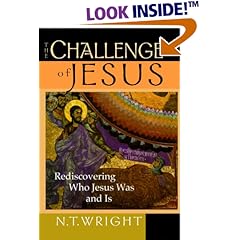 I couldn't get to sleep last night, so I decided to finish reading N.T. Wright's The Challenge of Jesus: Rediscovering Who Jesus Was and Is. (I finished at about 1:00am). I started reading this book during my breaktimes while I was working third shift at Rockwell; so, it has taken me a while to finish. (It was really difficult to concentrate on reading and thinking critically at 4:00am!)
As usual, Wright's book was both scholarly and pastoral in nature. Wright writes with the goal of having each reader grow in his or her understanding of the historical Jesus (one that is firmly planted within the first century Palestinian world) and to follow Him more faithfully in the twenty-first century.
Although I found many helpful discussions in this book (namely, Wright's discussion involving the way Jesus subverted the Jewish symbols in order to show Himself to be the true Israel, the true Temple where forgiveness and hope is found.) Yet, Wright's book is not without serious flaws. As one Amazon reviewer wrote,
one of these [flaws] is particularly serious, namely inadequate handling of the Atonement. Nowhere in the book's climactic chapter, `The Challenge of Easter' does Wright come close to explaining how Jesus' death can be the means of salvation or even transference of guilt. In fairness to the author, it is clear from passing comments elsewhere in the book that he vehemently disowns the view that Calvary was no more than an example to the infant church of the cross-bearing path it would have to follow. Nevertheless, he does not elaborate this conviction in the parts of the book where it matters most, and readers could be excused for inferring from the chapter under discussion that Jesus' painful death was little more than an inconvenient bridge he had to cross to get to his glorious resurrection.
The under-emphasis of substitutionary atonement was for me at least the most serious of several flaws including a rather too guarded analysis by the author of exactly what he means when he speaks of Christ's divinity, and in a lesser work these might have been fatal. But it really is too much to expect that any one book but the Bible itself can do justice to every strand of Christian truth.
2.01.2007
One Life, Two Tables
When reading through the Scriptures, one can clearly see that there are two types of people: those who love God and those who do not. We are either walking through the narrow gate that leads to life or through the wide gate that leads to destruction (Matthew 7:13,14). We either love Christ and obey Him or we do not love and obey Him (John 14:23,24). We are either sheep or we are goats (Matthew 25:32,33). There is no middle road on which to walk. There is no such thing as neutral men when when it comes to the condition of our hearts. There are no hybids in the kingdom of heaven. There's no room for fence-sitting.
In 1 Kings 1, we see that as King David lays in bed shortly before his death, his son Adonijah exhaltes himself by saying, "I will be king." (1 Kings 1:5). Adonijah calls for himself chariots, horses and men to run before him, and he alignes himself with Joab son of Zeruiah and with Abiathar the priest. He also called to himself his brothers and all the royal officials of Judah to feast and celebrate with him. Yet, not everyone stood with Adonijah. We are told that Zadok the priest, Benaiah the son of Jehoiada, Nathan the prophet, Shimei, Rei, David's mighty men and Solomon were not invited to feast with Adonijah (1 Kings 1:8,10).
The partly lines have been drawn. The men have pledged their allegiance. They have chosen between Adonijah or Solomon--between the self-appointed "king" and the LORD's anointed king. They have taken their places at different tables and prepared to eat at different feasts.
All of mankind will sit down to feast at one of two meals. One meal will fill men with every pleasure that the world can offer. They will fill their stomachs with temporary food that cannot satisfy. There meal will end in destruction and death. Yet, there will be those who sit down at the marriage supper of the lamb. They will feast upon Christ, the living bread that came from heaven, and they will be blessed and satisfied forever (John 6:51; Revelation 19:9).
Each person only has one life to live, but there are two tables set before each of us. Where are you feasting today?
“Come, everyone who thirsts, come to the waters; and he who has no money, come, buy and eat! Come, buy wine and milk without money and without price" (Isaiah 55:1).
Subscribe to:
Posts (Atom)