Showing posts with label Parenting. Show all posts

2.04.2010

Informed Quoters or Informed Readers?

In his article, "The Problem of Evangelical Biblical Illiteracy" David R. Nienhuis expresses his concern regarding Biblical illiteracy among those who claim to hold the Bible in high regard. In his opinion, knowing a few isolated Bible verses or being able to answer trivia questions should not be the goal of Christian education. He writes:
Knowing that Jesus was born in Bethlehem will not in and of itself empower them to speak the language of faith. Satan's use of Scripture in tempting Jesus is clear indication that a merely cognitive level of biblical literacy does not automatically result in the formation of a Christian character. To make a real difference in people's lives, biblical literacy programs will have to do more than simply encourage believers to memorize a select set of Bible verses. They will have to teach people to speak the language of faith...Biblical literacy programs need to do more than produce informed quoters. They need to produce transformed readers.
I believe that Nienhuis is correct. While I believe that Bible memorization is a good part of educating believers, it does not exhaust the task. Here are a couple of suggestions for helping people become transformed readers of Scripture.
  • Teach the Bible as a Story - From beginning to end, the Bible tells one grand story. The plot-line of the Bible moves from Creation to Fall to Redemption to Consummation. We must relate the many stories found within Scripture to the one, unified Story. In other words, we must not treat the Bible as a collection of unrelated stories; every story is part of the drama of redemption. (Recommended Resource: The Jesus Storybook Bible)
  • Ask the "So What?" Question - The goal of reading Scripture is not simply to make us more informed or knowledgeable. Facts are good, but they are not enough--even the demons believe certain facts about God (James 2:19). The things that we learn in the Bible regarding God, ourselves, and the world should lead us to action. For example, the proper response of the one who learns of his or her sinful condition and of Jesus' death and resurrection, is faith and repentance. Every time we read Scripture we should ask the "So what?" question -- "So, what should my response be to what God has revealed to me in His Word?"

10.06.2009

"I'm Bored"

"I'm bored."

8.22.2009

Family Worship and Alora's Song

During our family worship time each morning we take time to sing songs, read/act out Bible stories (using this awesome children's Bible), and learning from the First Catechism for children. Amy and I always hope and pray that God's Word will sink into our girls hearts. So, when we see the girls applying God's Word to the circumstances of life we are overjoyed. And that's exactly what happened yesterday.

For some reason our youngest daughter Ann-Marie Joy was crying in her room. When our oldest girl Alora Grace heard Ann-Marie, she decided to try and calm her down by singing a song. The great thing about the song is that Alora made it up and it is filled with truth about God. Since my wife has already posted the song on her blog, take time to check out Alora's song on Amy's blog.

7.21.2009

For the Kids and You

This book came in the mail yesterday, so I started reading it with Alora and Adalynne. They loved it! Definitely my top pick for a children's Bible. But don't be fooled...it's a great read for adults too. Buy it here.

5.28.2009

Discipline vs. Abuse

If we listen to the politically-correct rhetoric of our society for long enough, we may actually begin to believe that spanking is an inappropriate form of discipline. Some people would have us believe that spanking is a form of abuse and it teaches children to be violent. Yet, godly discipline--which includes spanking--is loving, not abusive. In the article, Spanking Stories, Doug Wilson makes this point abundantly clear:
People who do not know how to look beyond surface appearances will say that when you spank a child you are teaching them violence. They say spanking a child is hitting a child, and they are impatient with those who seek to make fundamental distinctions. Lovemaking is not rape, even though the same biological act is involved in both. Executing Ted Bundy is not imitating Ted Bundy, even though someone loses his life in both instances. The difference between child abuse and child discipline is as vast as the difference between unrighteousness and rightousness.
Continue reading Spanking Stories.

5.21.2009

No Need for Proof

Our children know that Amy and I are their mom and dad. We have been with them (almost) every day of their lives. Therefore, it would be quite strange if one of them said something like, "Could you give me some proof that you're really my dad?" This would be strange because they have every reason to believe that I am their father. For example, I live with them, I play with them, I look like them, etc.

In his book, Apologetics to the Glory of God, John Frame makes a similar point regarding those who grow up in a Christian home. He writes:
...many people grow up with God and receive him gladly. They hear about God in church, in Sunday School, around the family dinner table, and in Christian school. They see their parents making decisions based on the Word of God. They learn Scripture verses and catechism from memory. God is literally the head of their home. They could no easier doubt God's existence than they could doubt the existence of their own father or mother...God's norm for us is that we live and raise our children in such a way that proof will be unnecessary (65-66).
So, for those of us who are Christian parents, let us ask ourselves these questions: Are we raising our children so that they know that God's existence is as certain as our existence as their father or mother? Are we raising children in a way that proof will be unnecessary?

3.03.2009

Who is...?

Recently, I came across a website that has a lot of Bible Trivia Quizzes. The website has a large selection, so you're sure to find one that interest you. If you're a parent, why not plan to have a quiz/game night this week? Not only will you be spending time with your family, you'll also be growing in your knowledge of God's Word. You can check out the website here.

Here is a sample of the quizzes that are available:

New Beginnings

Books of the Bible

Bible Quiz for Kids - Old Testament

Bible Quiz for Kids - New Testament

Love and Marriage


8.27.2008

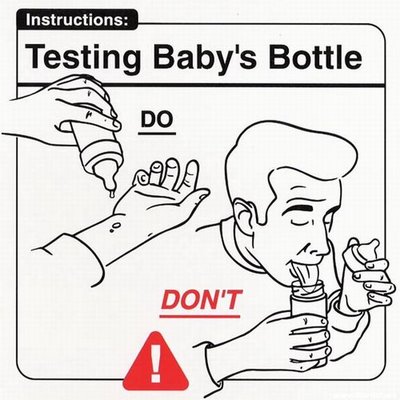
Bottle Testing Methods


In addition to a proper diaper changing method, parents should also be aware of the proper bottle testing method. Personally, the smell of warm milk grosses me out, so the tongue-in-the-bottle method was never an option for me.

2.27.2008

Diaper Checking Methods


I find that the one finger method is helpful. It's definitely better than the full hand method. (Though I've never personally tried that one.) Although it isn't listed, I find that the nose to the diaper method is quite faithful in determining if the foul odor is coming from your child's diaper or from some other source.

1.24.2008

The REBELution

Alex and Brett Harris want other teenagers join the REBELution and rebel with them. Yet, they aren't talking about the type of rebellion that is often exibited among teenagers. No, they want teenagers to rebel "against the low expectations of an ungodly culture." Find out more by going here. Also, be sure to check out the resource list.

8.15.2007

Recovering a Reformed Paradigm

In a previous post, From Infancy Onward, my hope was to point toward a different paradigm of how children within the church should be treated. Our children must be taught about the promises of God that belong to them. We must exhort them to believe and follow their gracious God in faith, for all of their lives. Sadly, in most evangelical churches, the children of believers are treated no differently than the children of unbelievers. Instead of trusting that God is at work in our children, we assume that they are in the same position as pagan children. We expect for them to go through some type of gut-wrenching conversion experience before we believe that they can really know the Lord. Yet, we must take into account the words of Peter where he proclaims, "For the promise is for you and for your children" (Acts 2:39). And do not let us forget the Apostle Paul's words in which he says that the children of believers "are holy"(1 Corinthians 7:14).

Of course, I wholeheartedly affirm that all of mankind is sinful and in need of the work of the Spirit. I am certainly a black-coffee Calvinist. "Truly, truly, I say to you, unless one is born of water and the Spirit, he cannot enter the kingdom of God" (John 3:5). But I also want to take into account the full scope of the Word.

Apparently, I am not alone in my thoughts. A couple of weeks ago I came across this lengthy quote from John. W. Nevin in this post called, On the Bench and Catechism. Check it out.

8.09.2007

From Infancy Onward

"Yet you are he who took me from the womb; you made me trust at my mother's breasts. On you I was cast from my birth, and from my mother's womby you have been my God."-Psalm 22:9,10

"For you, O Lord, are my hope, my trust, O LORD, from my youth. Upon you I have leaned from before my birth; you are he who took me from my mother's womb. My praise is continually of you." -Psalm 71:5,6

In his book, Paedofaith, Rich Lusk writes:
The Psalter treats infant trust not as a sporadic, occasional, or unpredictable reality, but as the norm in covenant children. God gives us believing children to work with and nurture. In this way, covenant children are a blessing and reward from the Lord. As we help them grow to mature faith, we fulfill the purpose of the cross-generational covenant promises. The psalmist has many remarkably deep, vivid, datable, and narratable experiences of God's grace, but he still maintains he was a believer from infancy; he trusted in God and knew Him from the very beginning of life. In this way, the Psalter norms Christian experience for the child growing up in a Christian environment. The experience of the psalmist should be the experience of our offspring. Our children belong to Christian homes and, like David, should learn to regard themselves as believers from infancy onward, not necessarily on the basis of experience, but as a corollary of the covenant promises.

5.27.2007

Alora's Prayer

Every night before Alora goes to bed Amy and I kneel down and pray with her. Although our prayers differ slightly each night, we always incorporate the greatest commandment (Mark 12:30) into our prayer time. Usually, I say a few words and Alora repeats after me. In the same way, we pray together before each of our meals.

Well, the other night at dinner time we all joined hands and I asked Alora if she wanted to pray with us. Yet, instead of waiting on me to begin the prayer, Alora began praying on her own: "Jesus, I love you with all of my heart, all my soul, all my mind, all my strength. Amen." Amy and I sat at the table in silence while our eyes filled with tears of joy.

Praise God for His grace! Praise God for our children! With the Psalmist we say, "Behold, children are a heritage from the LORD, the fruit of the womb a reward" (Psalm 127:3).

5.22.2007

The Joys of Potty Training

Alora gets so excited when she uses the potty, and so do Amy and I. We like to show our support by clapping loudly and doing funny dances. Okay, I'm really the only one who dances but that's beside the point. Usually, after Alora pees or poops in the potty, she wants to show us what she's done. So, she will either call us into the bathroom or she will bring the potty to us. Yet, if you aren't expecting to have pee or poop brought to you, it can be quite surprising. (For instance, the other morning I was sleeping in the bed and I was awaken by the smell of a fresh pile of poop. How's that for a wake up call!) Well, today Alora brought a potty full of pee into the living room to show us. Amy was on the couch and I was at the computer. Unfortunately, on her way to show me, Alora tripped over a toy and the pee poured onto the floor....and her! Oh, the joys of potty training!

5.09.2007

Fertility and Social Influence

Well, if you're looking for another great reason to have a large family consider the following point. In a recent blog entry, Of Babies and Believers, Dr. Al Mohler writes: "An obvious point to observe here is that fertility drives destiny when it comes to societies. Those who do not reproduce become, by default, less influential in the society. Meanwhile, those who do reproduce have the opportunity to inculcate their own worldview within their children." Finish reading the entry here.


4.29.2007

Ten Commandments of Parenting

We had a baptism today at Redeemer, and it reminded me of the great responsibility that all Christian parents have toward their children.

Hopefully, those of you who are parents (or will soon be parents) will find the Ten Commandments of Parenting to be a helpful reminder of how we should go about teaching and discipling our children.

3.22.2007

Better Whipped than Damned

"Train up a child in the way he should go; even when he is old he will not depart from it." -Proverbs 22:6
In the book of Proverbs, the issue of training a child focuses on two areas: wisdom and discipline. Regarding wisdom, we learn in Proverbs 1:7 that "the fear of the Lord is the beginning of knowledge; fools despise wisdom and instruction." Parents are to train their children to be wise by "fearing the Lord." Throughout the Proverbs, we read the call for the "son" to hear and head the instruction and teaching of his father and mother (1:8; 2:1; 3:1; 4:1; etc.). If the child follows the path of wisdom he will be shown "length of days and years of life and peace they will add to you" (Proverbs 3:2).

Unfortunately, due to sin, our children do not naturally desire to follow the path of wisdom. So, what must parents do in order to push their children away from foolishness and toward wisdom? In Proverbs 22:15 we read: "folly is found up in the heart of a child, but the rod of discipline drives it far from him." Discipline drives folly from the child, so that wisdom can take its place.

We must never seperate what God has joined together. If we give only wisdom, but no discipline, then we do not love our child: "Whoever spares the rod hates his son, but he who loves him is diligent to discipline him" (Proverbs 13:24). And if we have only discipline, but no wisdom, then we are simply hitting our child with no proper goal in view.

If we desire for our children to fear the Lord and follow Him in faith, then let us train them with both wisdom and discipline. Let us hold fast to the words of Proverbs 23:13,14 -"Do not withhold discipline from a child; if you strike him with a rod, he will not die. If you strike him with the rod, you will save his soul from Sheol." Or as Cotton Mather once put it: "Better whipped than damned."

10.30.2006

Groceries, Grapes, and a World of Learning

A few days ago, as Amy and I were standing in the fresh produce section of the grocery store, a woman came by and plucked a grape from the display and ate the grape. Soon after, the woman's daughter did the exact same thing. Unknowingly, the mother had just given her daughter a lecture in ethics. Unfortunately, I do not think that most parents realize how much they influence their children, for good and bad.

As parents, we are constantly before our children's eyes. As we live, they learn. We are the teachers and they are our students who soak in every lesson. Daily life provides us with the classroom, our words and actions serve as the lecture. Let us pray that our lectures are founded on curriculum of God's word, so that we can lead and exhort them to love and serve the Lord in faith. If our curriculum is based on any other foundation, then we are in the processes of educating fools.

Deuteronomy 6:1-9 (ESV): 1 “Now this is the commandment, the statutes and the rules that the Lord your God commanded me to teach you, that you may do them in the land to which you are going over, to possess it, 2 that you may fear the Lord your God, you and your son and your son's son, by keeping all his statutes and his commandments, which I command you, all the days of your life, and that your days may be long. 3 Hear therefore, O Israel, and be careful to do them, that it may go well with you, and that you may multiply greatly, as the Lord, the God of your fathers, has promised you, in a land flowing with milk and honey.
4 “Hear, O Israel: The Lord our God, the Lord is one.
[1] 5 You shall love the Lord your God with all your heart and with all your soul and with all your might. 6 And these words that I command you today shall be on your heart. 7 You shall teach them diligently to your children, and shall talk of them when you sit in your house, and when you walk by the way, and when you lie down, and when you rise. 8 You shall bind them as a sign on your hand, and they shall be as frontlets between your eyes. 9 You shall write them on the doorposts of your house and on your gates.

10.21.2006

Walking on the Road of Biblical Language

The way in which we communicate is highly important. If given the choice between clarity or confusion in communication, I am sure that we would rather walk on the road that is paved with simplicity, truth, beauty, and clarity than to stumble on the path of confusion. Yet, I wonder if it is possible that we have confused and misguided people by some of the pop theological terminology that we have chosen to speak. For example, let's talk about the following phrase: "Have you asked Jesus into your heart?" I am sure that many of us have used this phrase or at least something similar; and likely, most of us know what is meant by this phrase. Yet, if you ask a child this question, you are likely to see a confused look come across his or her face (unless of course we have already programmed him to think and speak the language of pop theology.) I have doubts as to whether this non-biblical language is helpful. (I am inclined to believe that it merely clouds the waters of understanding) Instead of asking if people have "asked Jesus into their heart," why don't we mimic the language of scripture and say something like this: "Have you confessed with your mouth that 'Jesus is Lord'? Do you believe that God raised Him from the dead? Do you trust that His death and resurrection will save you from sin" (Romans 10:9). By speaking this way, we can actually take people to the scriptures. Where in the Bible will you go to show someone that they must "ask Jesus into their heart?" You can't. Why don't we speak as God has spoken to us in the Bible? Why don't we give the language of the bible priority over the language of "churchianity." Does this mean that we should do away with all words and phrases that cannot be found within the text of scripture? Certainly not. Many non-biblical words (such as "trinity") are very helpful because they serve as a sort "short hand" for biblical doctrine. Yet, some words and phrases are not so helpful. Now, I do not currently have a large list of phrases that we should discard from our vocabulary, but I am sure that a list will continue to formulate in my mind.

All in all, I believe my proposal is simple: give the language of scripture priority. As much as is possible and profitable, teach and speak in the words and manner in which God has chosen to speak to us in scripture. Hopefully, if we faithfully follow this pattern we will open the gates of clarity, so that people can walk into the light of God's word.

4.25.2006

As for Me and My House...

"Now therefore fear the Lord and serve him in sincerity an in faithfulness. Put away the gods that your fathers served beyond the River and in Egypt, and serve the LORD. And if it is evil in your eyes to serve the LORD, choose this day whom you will serve, whether the gods your fathers served in the region beyond the River, or the gods of the Amorites in whose land you dwell. But as for me and my house, we will serve the LORD" (Joshua 24:15)(ESV).

We live in a society that places all of emphasis on the "individual." So, it is very easy for us to read through scripture and fall to notice the emphasis that is often places on entire households. Reread the passage above and pay attention to the references that are made to fathers and households. (Especially take note of the fact that Joshua spoke not only for himself, but also for his house). What implications does this make for our families today?

While reading tonight, I came across a quote that I think relates very well to this discussion:

"In the sight of God parents and children are one. The former are the authorized representatives of the latter; they act for them; they contract obligations in their name. In all cases, therefore, where parents can enter into covenant with God, they bring their children with them....It is vain to say that children cannot make contracts or take an oath. Their parents can act for them; and not only bring them under obligation, but secure for them the benefits of the covenants into which they vicariously enter. If a man joined the commonwealth of Israel he secured for his children the benefits of the theocracy, unless they willingly renounced them. And so when a believer adopts the covenant of grace, he brings his children within that covenant, in the sense that God promises to give them, in his own good time, all the benefits of redemption, provided they do not willingly renounce their baptismal engagements." --Charles Hodge, as quoted in Children of the Promise, p. 130.

So, what are your thoughts? The comment section is ready and waiting for you!